

The Logan Blue Sapphire
One of the world’s most recognizable sapphires is the Logan Blue Sapphire. On display at the Smithsonian since 1971, this gem weighs 422.99 cts. It’s the largest set gem in the National GemCollection and the second-largest faceted sapphire in the world. With a pure medium-blue color and excellent clarity , its quality is readily apparent to all visitors. The Logan Sapphire originated in Sri Lanka’s Ratnapura gem mining district, likely in the 1900s. Col. M.Robert Guggenheim purchased the sapphire as a gift for his wife, Rebecca Pollard Guggenheim, in1952. After his death in 1959, she donated the gem to the Smithsonian but kept it in her possession until 1971. Upon remarrying in 1962, the gem acquired her new surname, Logan.
Princess Diana’s & Kate Middleton’s Engagement Ring
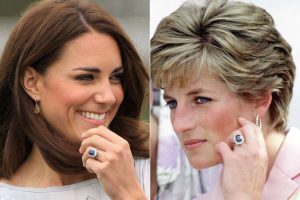
Heirloom engagement rings are a popular way for young couples to celebrate the old and the new. But few engagement rings are as high-profile and trend-setting as Kate Middleton’s. The ring was originally Princess Diana’s sapphire engagement ring. After her untimely death, her sons were each encouraged to keep a memento. Prince William chose a gold Cartier watch, while PrinceHarry picked the engagement ring. When William decided to propose to Kate Middleton, though, the brothers switched items. The 12-ct Ceylon blue sapphire was William’s way of including his mother on his wedding day.
Although the ring sparked controversy when Diana first chose it (the ring was a “commoner’s choice” rather than a bespoke item), it also sparked the biggest trend in gemstone engagement rings — twice! Oval-cut sapphire rings with a chunky diamond halo have been in demand since Princess Diana first wore hers, and seeing it on Kate Middleton’s finger gave the trend new breath.
The Blue Giant of the Orient
 In 1907, miners in Sri Lanka’s Ratnapura district unearthed the stone that would become the largest faceted sapphire in the world. Weighing over 600 cts rough, lapidaries cut the medium-blue sapphire down to 466 cts. An anonymous American collector bought the massive gem, dubbed the Blue Giant of the Orient, and it disappeared from public view until 2004. The Blue Giant of the Orient reappeared in Christie’s Magnificent Jewels auction in Geneva, Switzerland, now described as a 486.52-ct Kashmir sapphire. The discrepancy in weight was likely due to differences between traditional and modern weighing methods, while the term “Kashmir” probably referred to color and quality, rather than origin. Although the gem didn’t sell at auction, a private buyer later purchased the sapphire reportedly for a million dollars.
The Stuart Sapphire
 The oldest sapphire on this list, the Stuart Sapphire is currently a part of the British crown jewels. This asymmetrical, oval-shaped gem likely originated in Sri Lanka in the late 12th century CE. It fi reappeared in the West in 1214, set in the crown of the Scottish King Alexander II at his coronation. This104-ct sapphire was passed on to his son, Alexander III, who died without a clear successor. His infant granddaughter became Queen of Scotland, but she fell ill and died on a journey to England to meet her betrothed, Edward II. King Edward I of England then attempted to seize the Scottish throne. Although unsuccessful at first, then eventually became the ruler of Scotland and also acquired the sapphire. The gemstone passed to Edward II, then to Edward III amidst tumultuous wars with Scotland. Edward III returned the sapphire to David II of Scotland, who presented it as a gift to his sister. After surviving political turmoil, the Stuart Sapphire was incorporated into a new crown for QueenVictoria in 1838. In 1937, the old crown was getting weak, so a new crown was made to replace it, incorporating the same jewels. This crown is on display as part of the crown jewels at the Tower of London.
The Bismarck Sapphire
 Countess Mona von Bismarck once owned this 98.6-ct sapphire. Although its deep cornflower-blue color is darker than most on this list, the stone is still vibrant and lively. She likely purchased it during a 1926 trip to Sri Lanka, where the gem originated. The gem’s well-proportioned cut indicates that Cartier likely re-cut the gem prior to mounting it in its current setting. In 1967, the Countess donated the necklace to the Smithsonian, where it’s been on display ever since.
Princess Eugenie’s Engagement Ring
 This ring featured a large Padparadscha Sapphire, a rare stone that has a pink tint to it, surrounded by diamonds. At the time, now-husband Jack Brooksbank said he chose the ring because, ‘it changes colour when it hits certain lights, much like Eugenie’ – very romantic.
Speaking about Eugenie’s precious piece of jewellery, which contains the rarest of all sapphires which usually come from Sri Lanka, an Industry export said: “Nothing brings to mind blooming flowers like padparadscha sapphires. Named after the colour of a lotus blossom, the pinkish-orange glow of these stones are hypnotising.”


