
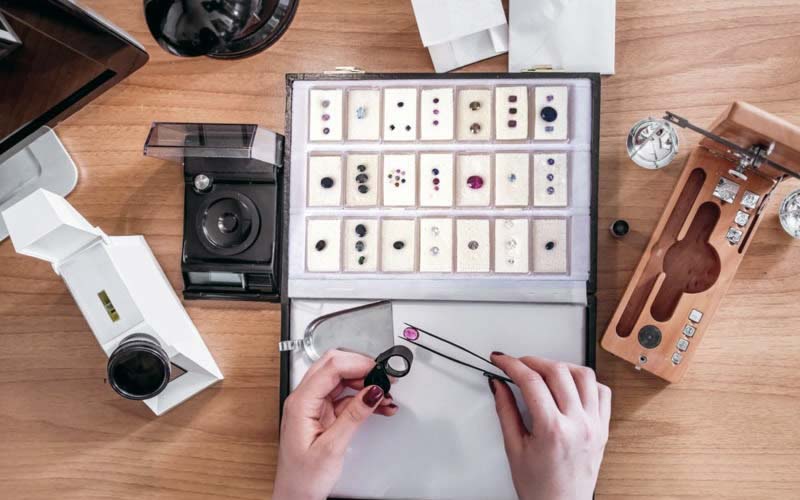
The quality and value of a gem are judged on seven fundamental criteria known as the ‘six C’s & T.’ The carat-weight, colour, clarity, treatment and cut…and the most important C of all, confidence. Confidence is found in the form of a trusted gem lab certificate. Some differences in quality are easily noticeable, others need specialist equipment and qualified graders with years of experience to assess and detect.
In addition to the 6 C’s, laboratories test for Treatments, which enhance the colour and clarity of the gem. Treatments such as fracture filling, defusing, laser drilling and high-temperature high pressure, significantly reduce the value of the gem and should be disclosed.
The quality and value of a gem are judged on seven fundamental criteria known as the ‘six C’s & T.’ The carat-weight, colour, clarity, treatment and cut…and the most important C of all, confidence. Confidence is found in the form of a trusted gem lab certificate. Some differences in quality are easily noticeable, others need specialist equipment and qualified graders with years of experience to assess and detect.
In addition to the 6 C’s, laboratories test for Treatments, which enhance the colour and clarity of the gem. Treatments such as fracture filling, defusing, laser drilling and high-temperature high pressure, significantly reduce the value of the gem and should be disclosed.
Cut
The cut of a gem is a property, which is highly dependent on man. Cut refers not only to the shape and style of the diamond, but its proportions, symmetry, and finish or make.
Proportions and angles influence the internal reflection of light as well as the dispersion of light leaving the gem. This determines the brilliance and fire (brightness and sparkle) of the diamond, and ultimately it’s perceived beauty.
Cut, therefore, is actually one of the most important aspects to consider when choosing your gem. A gem can be cut for maximum weight recovery or maximum brilliance and beauty. Invariably one is traded of at the expense of the other. Although poor makes sell at a discount in the trade, realistically the unsuspecting retail customer will pay the same price regardless of make. Ultimately taste and preference for the overall appearance determine the buyer’s choice.
Colour
Color is one of the first traits one notices when looking at a gemstone, and what makes jewels so desirable. Rubies are famed for being red, emeralds for their greens, and opals for their flashes of color.
Hue varies quite a bit. Even jewels of the same species, with the same trace elements and unearthed in the same location may have variations in color. To help understand this trait, here are a few terms.
“Body color” refers denotes whether a jewel is red, green, or another hue, how light or dark the stone is, and how intense the color. A number of factors influence a jewel’s body color, including the stone’s chemical formula, the presence of any trace elements and how the gem is cut. Some gems may have other hues in addition to its body color, and are given additional classifications.
Most gemstones are famed for having a specific shade or shades that are considered especially beautiful. More famous examples include pure blue for sapphires, and pure green to bluish green for emeralds. This is a jewel’s “fine color”. Demand for a gemstone’s fine color is higher than demand for other available hues, and tend to have a greater value. Gem cutters will try to fashion stones to achieve fine colors.
A stone’s “color range” denotes the available colors in a given gemstone. Color range may be narrow, like peridot’s yellow greens, to nearly every hue such as sapphire and tourmaline. While some hues in a color range may be more popular than others, many designers like to create jewelry that plays along with the entire range, like suites of jewelry with blue, yellow and pink sapphires.
Clarity
Clarity refers to the internal landscape of inclusions that is inside the gem or blemishes that are on the exterior of the stone. The inclusions may be minute crystals of the same mineral, crystals of another mineral, tiny gas bubbles, small liquid filled pockets, internal fractures or cleavages, or any other visible matter inside the stone. These may form as one or more crystals or form in fine microscopic “clouds”.
Clarity refers to the internal landscape of inclusions that is inside the gem or blemishes that are on the exterior of the stone. The inclusions may be minute crystals of the same mineral, crystals of another mineral, tiny gas bubbles, small liquid filled pockets, internal fractures or cleavages, or any other visible matter inside the stone. These may form as one or more crystals or form in fine microscopic “clouds”.
Internal fractures are common in some varieties of gems; if they are large or extensive, avoid buying the gem because the durability may be affected.
Blemishes are external features that include chips, scratches, abrasions, naturals on diamonds and spots on pearls.
The inclusions in a diamond greatly influence the value of a diamond; in coloured gemstones, the inclusions generally have less bearing on the value. Some gemstones have eye visible flaws that will detract from the gem; others have microscopic inclusions that will not detract from the stone’s beauty. Inclusions in colored gemstones should be considered a negative factor if the durability could be affected or if the brilliance of the gemstone is lessened. Inclusions are not always a negative feature. Some inclusions can enhance the beauty or add to the mystery of a gemstone; it is the inclusions that create stars in asterated gemstones and the flash in moonstone. Inclusions can identify a gem or indicate its origin, even add to its value. In diamonds each flaw or blemish lowers its clarity grade, hence lowers its value. In rubies and sapphires, inclusions may pinpoint where the stone was mined or whether it was heated.
In accordance with FTC (Federal Trade Commission) guidelines, diamonds should be clarity graded by a ten-power hand held loupe or microscope. The way a diamond reflects light within the stone makes it difficult to see inclusions with the naked eye. Clarity grading of diamonds will be thoroughly discussed in the chapter on Diamonds.
diamonds should be clarity graded by a ten-power hand held loupe or microscope. The way a diamond reflects light within the stone makes it difficult to see inclusions with the naked eye. Clarity grading of diamonds will be thoroughly discussed in the chapter on Diamonds.
Colored gemstones do not have rigid guidelines for grading clarity. Colored gemstones can be viewed in a couple of ways to quickly assess clarity without magnification. First, put the stone table down on a white surface or piece of paper. Any substantial inclusion will be clearly visible. The second method requires a penlight with a flat area where the light comes out; merely place the stone table down over the light source; when the light is on, most inclusions will become very obvious.
Carat
Carat is a unit of measurement that is used to determine size in gemstones. One metric carat is equivalent to one fifth of a gram, or 200 milligrams. Jewels are often measured to a one hundredth of a carat, or 0.01 carats. Due to the different chemical formulas, elements and density that make up different gemstones, jewels of two different species with the same cut and dimensions may have different carat weights.
While some gemstones such as topaz are available in a vast range of carat sizes, others are less common over a certain size, like tsavorite garnets larger than five carats. The environment in which some gemstones form, such as pegmatites, can allow for massive rough. In other circumstances, the heat and pressure that creates mineral jewels only allows for smaller stones to form. Due to rarity, the price per carat of less common large stones rises. With all other factors being equal, a one carat stone is more valuable than its half carat cousin.
Some gemstones are prized for colors that look their best in larger carats. Bigger crystals may have more intense hues, especially with stones that lean more towards pastel tones, like kunzite or aquamarine. A heftier carat weight for such jewels can help create an intense color sought after by connoisseurs.
Country
Country of Origin is also a major factor that affects the value of a gemstone.
For many coloured gems, the country of origin, or the mining location, greatly affects the value. For example, this is truer and more extreme for an untreated sapphire of intense blue colour from Kashmir or Ceylon, which is worth far more than a similar sapphire mined elsewhere. A few of the major grading labs have the equipment and expertise to determine geographic origin. An origin report from one of these labs is required to invalidate the gem’s value when highly regarded locations can significantly increase the stone’s price. Further, some gems such as Kashmir sapphire have a collectors value also as they are getting rare day by day due to the scarcity of the supply.
Be cautious and read the report from a lab thoroughly. A standard report usually identifies the gem material, but not the geographic origin. The language used in a standard GIA Identification Report for a copper-bearing tourmaline will state, “This copper and manganese bearing tourmaline may be called ‘paraíba’ tourmaline in the trade. The trade term ‘paraíba’ comes from the Brazilian locality where this gem was first mined, however, today it may come from several localities.” The trade calls these gems Paraíba tourmalines even though the location is not from Brazil. Only if the gem was sent in for a country of origin report, will it indicate the country, such as Brazil. In that case, the price will be impacted by Brazil origin.
Ruby, sapphire, red spinel, emerald, and Paraíba tourmaline all qualify for gem labs Colored Stone Identification & Origin Report. However, that does not mean Gem labs will be able to determine a country of origin in every instance. Gem labs determine geographic origin by collecting chemistry and spectroscopic data, and identifying types of inclusions on the sample of unknown origin. That data set is compared to sets of data from reference gems of known origins, looking for compelling evidence that indicates that the unknown is from a certain location. If the data overlaps with gems from two locations or more, and gem labs cannot reach a definitive relationship to one location, the report has the result of “inconclusive.”
Confidence
A good reputable gem dealer is the first step to an intelligent gem purchase. Your gem dealer should be knowledgeable about gem and help you feel comfortable making this important purchase.
Next, always insist on a gem lab certificate from an independent and recognized gem testing laboratory. A reputable gem dealer will gladly supply an independent testing report on the gem. Why independent? This assures an unbiased and objective evaluation of the gem. Often a conflict of interest may exist in the same person selling the gem determines the grade. Why a laboratory? A good lab will have advanced equipment providing for a more accurate assessment. Certain characteristics, such as treatments and enhancements, will only be detected and disclosed by a specialist laboratory.
Without a gem testing report, unscrupulous dealers are able to sell treated or synthetic gems to unsuspecting customers.
Treatments
Treatments or enhancements occur after the gems are formed. Thus, an enhanced gemstone isn’t necessarily a synthetic stone, nor are synthetics necessarily enhanced gemstones.
- Heat Treatment
The most common form of enhancement is heating. For example, jewellers should inform their customers that weather their rubies and sapphires are heated or not since heating is so common for corundum gems. Regular heating is an industry-accepted method. which enhance the colour and clarity of the gemstone. Heat enhancement so closely resembles what happens in nature that you can’t always tell if gems have received the treatment after mining. Sometimes, microscopic examinations can reveal evidence of heating. Otherwise, you can’t tell if the heating occurred before or after mining.
- Radiation
Radiation is a scary word. Revealing that a gem was irradiated will likely drive away customers. But just as with heating, radiation enhancements duplicate what happens in nature. During their formation, radioactive elements affect many gem crystals. That doesn’t mean these gems are radioactive or otherwise harmful.
Most blue topaz gems get their color in a two-step enhancement process. First, radiation modifies electron sharing between certain atoms in the crystal structure of colourless topaz, which turns the stone brown. Next, heating creates a stable blue colour.
- Oiling
Some gems, notably emeralds, have internal fractures. Light reflection off their surfaces seriously affects the clarity and brilliance of these stones. Simply filling these fractures with a substance with similar optical properties makes these tiny cavities transparent. The difference in the appearance of the finished gem can often be startling! Many different kinds of oils or fillers can be used on emeralds, and many people in the gem trade have long debated their relative merits.
Unlike heat and radiation, oiling gemstones doesn’t mimic a process that occurs in nature. To gem cutters, oiling poses a serious problem, because those tiny fractures represent structural weaknesses they must consider in the cutting process. Oil-masked fractures increase the risk of damaging a gem during cutting. To gem owners, oiling is well worthwhile, since the oil filler isn’t visible and simply allows the natural beauty of the stone to shine. For them, gemstone enhancements like oiling increase both the emotional and monetary value of the gem.
Jewelers should tell buyers that oiled gems need special care. For example, frequently washing dishes while wearing such a stone can make it less brilliant. Vigorous cleaning methods, like using heat or an ultrasonic system, can be disastrous.
- Dyeing and Sealing
Less expensive gems can receive enhancements, too. Dyes are common treatments for stones such as black onyx. Jewellers often seal porous materials like turquoise with surface coatings, such as paraffin wax, so body oils won’t cause discolouration.
- Lead Glass Filling
Diamonds, rubies, and sapphires can be filled with lead glass to improve their clarity. Some gems that combine naturally with synthetic material may also be called “hybrid gems.”


Leave A Comment